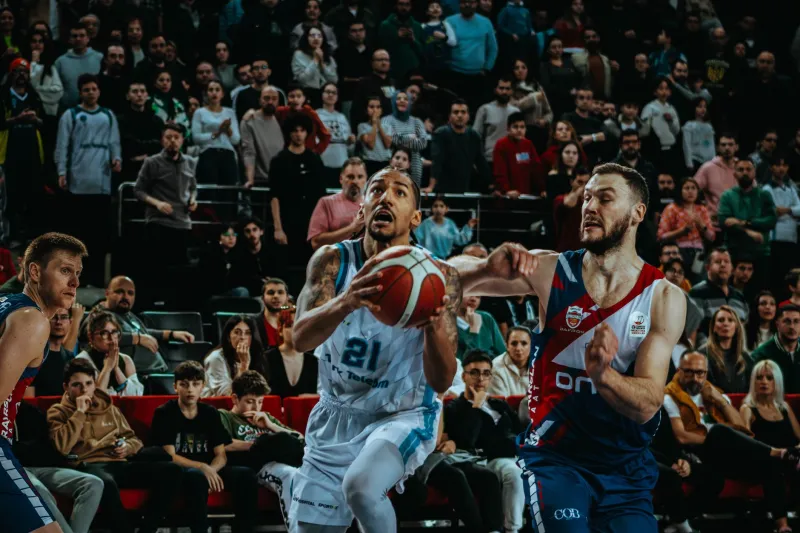
The Assist Nobody Scouted: How American Point Guards Become Kings Overseas

Photo by Photo by Zach Rowlandson on Unsplash on Unsplash
There's a moment that happens in EuroLeague arenas every single winter that American fans almost never see. An American guard — one who bounced between two-way deals and G League call-ups for four years — walks to the free-throw line in a packed Serbian gym, 14,000 people whistling at him, and calmly sinks both shots to ice a road win.
Back home, he's a trivia answer. Over there, kids wear his jersey.
This is the story of a career path the NBA draft industrial complex doesn't really have a name for, but every international scout knows by heart. Call it the Overseas Floor General Arc — and if you want to understand the FIBA game, it might be the single best case study available.
The Skill Set Nobody Drafts For
Here's the uncomfortable truth about NBA point guard evaluation: it's mostly a measurement of explosiveness. Can you blow by a defender? Can you create separation against a 6'8" wing with a 7'2" wingspan? Can you survive 82 games of athletic freaks hunting you on defense?
That's a legitimate filter. It's also a completely different test than the one FIBA basketball administers.
The international game rewards a different résumé entirely. Shot clocks that force faster decisions in the halfcourt. A physical, hand-check-adjacent style where refs let you play through contact. A 40-minute game where a five-point lead in the fourth quarter is a fortress, not a formality. And most importantly — a role. In Europe, you're not asked to be the best player. You're asked to be the right player, on a roster that might have three other guys who also think they're the right player.
The American guards who thrive over there aren't the ones who couldn't stick because of talent. They're the ones who couldn't stick because the NBA never had a role for what they do best: run a team, hit the open shot, make the correct pass on 30 consecutive possessions, and keep your composure when the crowd is throwing things at the tunnel.
A Journey Through the Stops
Picture a composite of the dozens of guards who've walked this road — because the map is remarkably consistent.
Stop one: a mid-major college career. Three or four years running an offense, maybe a conference tournament run, a name that shows up on analytics nerds' spreadsheets. The NBA combine invites a few dozen guards. This guy isn't one of them.
Stop two: Summer League limbo. A strong showing in Las Vegas, an Exhibit 10 deal, a season of G League basketball where he averages 14 points and 7 assists and nobody notices. The stats don't matter. What matters is that a Spanish team's agent network is watching film, and what they see isn't athleticism — it's decision-making.
Stop three: the proving ground. Second-division Spain, or France's Pro B, or the Adriatic League. This is where careers die or get forged. The pace is slower than the NBA but the physicality is higher — bigs screen harder, defenders hold more grab, and the officiating makes you earn every drive. Guards who survive this stop learn the single most transferable skill in basketball: playing at multiple speeds.
Stop four: the EuroLeague call-up. Someone gets bought out, a roster spot opens, and suddenly our floor general is running offense against Real Madrid in front of 10,000 people with drums. If he delivers — and the ones who become legends always deliver — he's no longer a prospect. He's a professional.
Stop five: the passport life. Greek League playoffs. A Turkish Airlines EuroLeague contract with real money. Maybe a national cup final where he hits five threes and becomes a permanent answer to a pub trivia question in Athens.
Why the FIBA Game Loves This Guy
Think about what a FIBA game actually demands from a point guard, possession by possession:
- The 14-second offensive reset. After a defensive rebound, you've got 14 seconds to attack. That's not a sprint — it's a decision tree. The great overseas guards make the right read in two seconds and spend the other twelve executing it.
- The trapezoid lane and the shorter arc. Spacing is different, drives come into traffic faster, and the corner three is a few feet shorter. Shooters adjust. Passers adjust more.
- Zero-tolerance for hero ball. Coaches in Europe will bench a max talent for a bad shot. They'll absolutely bury an American import who tries to play his old G League tape. The guards who last learn that the offense has a hierarchy and their job is to serve it — until the last four minutes, when the hierarchy dissolves and it's their ball.
- The crowd. This is the underrated one. Playing in Belgrade or Athens or Thessaloniki means playing inside a wall of noise where visiting teams win maybe 30% of the time. The American guards who become legends over there are the ones who treat hostility as fuel instead of pressure.
That last one is why so many NBA role players shrink in FIBA competition while career journeymen thrive. It's not talent. It's temperament.
The Money Nobody Talks About
One more thing worth knowing for the American fan wondering why anyone would take this path: the money is real. A solid EuroLeague rotation guard makes seven figures. A star makes multiple. Add tax-friendly countries, housing, and a lifestyle where you're a celebrity in a city of two million instead of anonymous in one of nine million — and the calculus starts looking less like a fallback and more like a smart career choice.
Some of these guys spend a decade abroad, marry a teammate's cousin, learn Serbian, and become assistant coaches in Milan. Some come home in their early 30s with a trophy case and a scouting-report-level understanding of the international game that NBA front offices suddenly, conveniently, want to hire.
The Next Time You Watch
So here's your homework for the next FIBA window or EuroLeague highlights reel you stumble onto at 3 a.m. Find the American guard. Watch how little he forces, how quickly he gets his team into offense, how he seems to know the score and the clock and the foul situation at all times.
Then ask yourself: why did no one in the NBA want this?
The answer, usually, is that they did — they just wanted a different version of him. And the version FIBA wanted turned out to be the one who ends up with a statue someday. Maybe not a literal statue. But in Athens or Vitoria or Tel Aviv? Close enough.