While the NBA Sells Pickle Juice Ads, FIBA Coaches Are Drawing Game-Winners on a Whiteboard
You know the scene. Two minutes left, NBA Finals, the game hanging in the balance. The whistle blows, the timeout gets called, and then... nothing. You get three minutes of insurance commercials, a promo for a show you'll never watch, and a sideline reporter asking a coach a question he's contractually obligated to answer in the dullest way possible. By the time the action resumes, your pulse has flatlined.
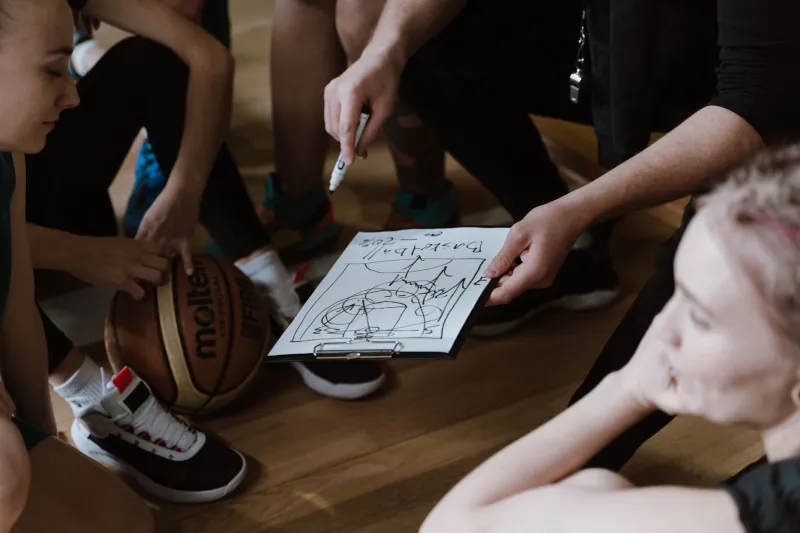
Now flip the channel — or better yet, rewind to a EuroBasket semifinal or a FIBA World Cup quarterfinal. Timeout gets called and the entire building leans in. No ad break. No buffer. The huddle forms in seconds, the crowd is deafening, and the coach has roughly twelve seconds to draw something that changes everything. It's the most honest theater in basketball, and American broadcasts have been sleeping on it for decades.
Twelve Seconds, No Commercials, All Stakes
FIBA's broadcast model treats a timeout like what it actually is: part of the game. The cameras stay on the huddle. You hear the coach barking, you see players nodding, you feel the crowd's noise swallowing everything. There's no air to breathe between the drama — and that's exactly the point.
Compare that to the NBA, where a sixty-second timeout somehow becomes a four-minute broadcast black hole. The league sells those breaks, sure. That's the business. But the product suffers. Crunch time in an NBA Finals game has been sanded down into a slog of sponsor reads and dead air, while the actual tension leaks out of the building one commercial at a time.
Three Huddles That Flipped History
If you think a huddle can't be must-watch TV, you haven't paid attention internationally.
1. Turkey, 2010 World Cup. Coach Bogdan Tanjević had a squad of overachievers playing in front of a home crowd in Istanbul. In the semifinal against Serbia, his huddle management — calm, almost professorial, drawing up sets that exploited Serbia's switching — helped engineer a late run that sent the hosts to the final. The broadcast stayed glued to that huddle, and you could see players' body language transform in real time.
2. Argentina, 2019 World Cup. Sergio Hernández, the wizard behind Argentina's golden generation, ran huddles like a street magician. Against France in the semifinal, his late-game adjustments — quick-hitting sets that got Campazzo attacking downhill — flipped a two-possession game. The cameras caught him tapping his temple, players laughing nervously, then executing like surgeons.
3. Germany, 2023. Gordon Herbert's huddle work during the final against Serbia became the stuff of legend. With Germany trailing in the fourth, his adjustments — space the floor for Schröder, trust Dennis to make the read — were drawn up in a huddle that lasted barely longer than a TikTok. Germany won its first ever World Cup gold on the back of that fourth quarter.
In each case, the broadcast didn't cut away. The huddle WAS the show.
What the NBA Could Actually Steal
Nobody's saying Adam Silver should ban commercial breaks — that money pays for everything. But there's a middle path.
Keep cameras on the huddle during breaks. Even if the broadcast goes to a split screen or a picture-in-picture, let viewers see the coach drawing, the players reacting. It costs nothing and adds everything.
Tighten the return-to-play window. The gap between the end of a timeout and the next possession in the NBA is often 90+ seconds of nothing. FIBA games resume almost instantly. The rhythm keeps fans engaged instead of reaching for their phones.
Mic the huddle (within reason). You don't need to give away secrets, but ambient audio — the urgency, the emotion — turns a dead break into live drama. FIBA broadcasts do this naturally. The NBA sanitizes it into silence.
The Bigger Picture
Basketball fans in the US have been trained to accept that big moments come with commercial interruptions, like a tax on excitement. But watch a FIBA knockout game and you realize the tension doesn't need a three-minute breather to land. Sometimes the most dramatic moment in a game is a coach scribbling arrows on a board while 15,000 people scream.
The NBA has the best players on Earth. It doesn't always have the best presentation of big moments. That's a fixable problem — and the blueprint has been sitting on FIBA broadcasts for years, twelve seconds at a time.